


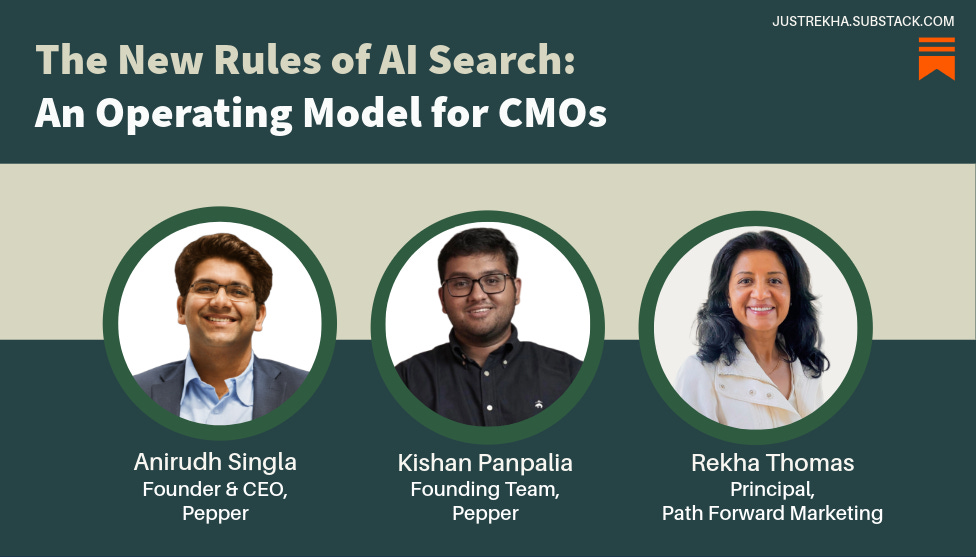
Many marketing leaders keep telling me the same thing right now. They know AI search is changing how customers buy, but they’re just not sure what to do about it. They’re well past deciding whether to pay attention to GEO (generative engine optimization) or AEO (answer engine optimization). The real challenge CMOs are grappling with is figuring out how to embed AI search into a new operating model, instead of treating it as yet another marketing program.
That’s exactly the topic what we discussed at the first Forbes Communications Council CMOs Group event on March 19th. I was joined by Anirudh Singla, Founder and CEO of Pepper, an AI-native content and GEO platform working with more than 250 enterprise brands including Amazon, Adobe, Meta, and Atlassian, and Kishan Panpalia, a Founding Team member at Pepper and a recognized GEO expert who’s worked directly with Fortune 1000 CMOs on AI search. What followed was a conversation on trends in AI search and actionable takeaways for marketing leaders to implement right away
This piece covers the gist of my conversation with Anirudh including what AI-native truly means, how the buyer journey has changed, and what all of it means for CMOs when it comes to mindset, budget, KPIs, and org design. At the end, I share the ten foundational areas Kishan walked us through for showing up in LLMs, and where to get the full deck.
What AI-Native Actually Means
Everyone uses the phrase “AI-native” today. I asked Anirudh what it actually means, not as a buzzword, but from the perspective of a founder who’s building an AI-native company.
Eight years ago, Pepper was in the business of helping enterprises scale content production. Pre-AI, they were producing around 40,000 content assets a month for some of the largest global enterprises using human experts. Then they raised a round of funding from Lightspeed, and on the exact day they signed the term sheet, GPT-3 was announced. The pervasive headline was that AI could potentially disrupt the entire content production industry, the very industry Pepper had just raised money to compete in.
Rather than cling to the old model, Anirudh reached out directly to Sam Altman and Greg Brockman at OpenAI. This was two years before ChatGPT formally launched, and he received a response to his email in an hour! This was the moment that Pepper decided to pivot. They completely rebuilt their business with an AI-first foundation, potentially killing the business model they had just been funded to scale.
“If you take older processes and try to fit them into what AI should look like, it’s going to be a very uphill battle. But if you reimagine those things with AI, if you were to build them from the ground up, it’ll be a very different company.”
- Anirudh Singla, Founder & CEO, Pepper
He pointed to tools like Clay and the new wave of AI-first CRMs as examples of companies building from the ground up in a fundamentally different way, built by people who think in AI. His analogy is that college graduates entering the workforce right now will have fundamentally different skills than any previous generation, because they are approaching productivity and scalability through an AI lens from day one. That is not adoption of a new tool. It’s a behavioral reset.
AI-native is not about which tools you buy. It’s about whether you are willing to reimagine your workflows, your team structure, and your entire approach to go-to-market from the ground up. An AI-first leader is open to redesigning processes even if they work today, so that they work 10x better.
The Buyer Journey Has Already Changed
We talk a lot about AI as a technology shift, but there is a behavioral shift happening right now in how buyers discover and research brands and products, and it is moving faster than most attribution models are capturing. I asked Anirudh about his take.
According to Anirudh, when a traditional user was searching on Google, they expected 10 links. For a B2B software evaluation, they would go to G2 for reviews, check Reddit or Quora for community takes, maybe ask questions in Discord. That entire fragmented research process, spread across a dozen platforms, has now collapsed into a single interface. Buyers are going to ChatGPT, asking a series of questions, and getting a synthesized answer with pros, cons, and a shortlist of vendors, all in one place.
This has profound implications for brands.
“Even though you exist on the internet, you might not really exist in front of the buyer, if your content doesn’t get surfaced.”
- Anirudh Singla, Founder & CEO, Pepper
He shared a specific example that should be a wake-up call for any CMO who assumes brand equity will carry them. Two of the most recognized names in CRM, do not consistently show up on Perplexity when someone searches “best CRMs for small businesses.” Not because they aren’t known but because smaller, more agile companies have built the kind of multi-surface authority that LLMs reward.
LLMs are acting like a detailed analyst, synthesizing everything a buyer needs, pros, cons, comparisons, and alternatives, in moments. That brings down both the cost and the time it takes to make a decision. Pepper is seeing this in its own customers; buyers who discover products via LLMs like ChatGPT and Gemini are converting at higher rates than those coming through traditional Google Search. The AI-assisted journey is higher quality because the buyer has done more research before they ever reach a vendor’s website.
Today, AI traffic might still represent only 3 to 5 percent of your total website traffic. But that traffic is your highest-intent traffic.
The CMO Mindset: Multi-Surface Authority
One of my favorite moments in the conversation was when I pushed Anirudh on what the changing buyer journey actually requires from CMOs at a mindset level. Most of the people on our call are not sitting on the sidelines. They know they needed to think beyond the traditional blue links of SEO. The question is, how do you go about it?
His answer was clear. GEO, is not just about optimizing your website. Your website accounts for roughly 50 to 55 percent of the equation. The remaining 45 percent is everything else, the surfaces that LLMs are drawing from when they construct answers. Right now, YouTube is the most cited source for both B2B and B2C businesses across LLM platforms. Reddit and user-generated content carry the highest algorithmic weighting. LinkedIn is increasingly important for B2B brands, with posts, Pulse articles, and employee content all being indexed and cited.
Anirudh’s advice was to think of each platform as a signal. The moment LLMs see a consistent signal from YouTube, from Reddit, from LinkedIn, from your website, and from an authoritative list in a reputable publication, all reinforcing the same brand narrative, they build the credibility to confidently surface you in an answer. On the flip side, if those signals are fragmented, inconsistent, or absent, you may be well-known and still invisible at the moment of the buying decision.
“The platforms you need to optimize for LLM visibility are not just restricted to your website. These are all channels which are signals that LLMs are absorbing from multiple places to give you more weightage as a business.”
- Anirudh Singla, Founder & CEO, Pepper
The mindset shift every CMO needs to make is from “how is our SEO performing?” to “across all the surfaces where buyers are doing their research, how consistently and credibly does our brand show up?”
Budget and ROI: GEO Is Not a New Line Item
I asked the question every CMO on the call was thinking, given that GEO requires investment across more surfaces, how should marketing leaders think about budget, especially when budgets are flat or shrinking?
Anirudh’s answer was clear, there is no separate SEO budget and GEO budget.
“Good GEO is also 70% of good SEO. It’s not two different things in terms of how people need to look at it.”
- Anirudh Singla, Founder & CEO, Pepper
The question is not whether to create a new budget line. It is how to reweight emphasis within the existing investment. His recommended allocation: spend roughly 50 percent of your time and budget on your own website. Not because the website is sufficient, but because it is foundational. Be sure that you have technical SEO hygiene so crawlers can move through it easily, and content that accurately reflects your current positioning. He flagged a specific problem Pepper is seeing from enterprise customers, LLMs are surfacing factually inaccurate information about companies’ products and positioning because the website has not been maintained. If your own web presence is not strong, everything else you build on top of it is on shaky ground.
The remaining 50 percent should go toward authority surfaces, with the right mix depending on your business. For consumer brands, the bet is video and YouTube. Anirudh’s prediction is that within 6 to 9 months, a lot of the textual AI summaries we see today will shift to short-form video formats, and companies that start building that capability now will have a real advantage. For community-driven brands, Reddit is important, but only if you treat it as social community activation, not content distribution. Reddit is aggressively anti-promotional. For B2B companies, LinkedIn is the most immediate investment, because it gives LLMs context about your business from multiple angles such as your products, positioning, people, and ultimately your credibility as a category leader.
Measurement: The Attribution Gap
This is where I pushed hardest, because it’s the question every CMO has to answer because ultimately they’re measured on pipeline. How do we connect GEO activity to real business outcomes when the attribution models have not caught up?
Anirudh was honest about the challenge. There is no Google Search Console equivalent for LLMs. But here’s what is happening: Buyers are doing all of their research inside the LLM. They ask questions, get synthesized answers, read everything they need, and then they skip the blog and go directly to your homepage to fill out a form. That lead shows up in your CRM as direct. Not organic. Not AI-assisted. Direct.
“If you just measure organic, it’ll just feel like everything’s going down, and that’s what we’re seeing across the board. There is a confluence of direct plus organic traffic that will become a big play in GEO.”
- Anirudh Singla, Founder & CEO, Pepper
So, if you are watching organic traffic decline and treating that as a performance signal, you may be misreading it entirely. Watch the blend of direct and organic together. And build self-reported attribution into your high-value lead capture flows through a simple “Where did you first hear about us?” that captures responses like ChatGPT, Gemini, or AI search. Anirudh shared a real example: an enterprise B2B customer closed a $500,000 deal from a prospect who searched for “best alternative solutions for…” in an LLM, found the company, and booked a demo, never clicking a single organic link. That deal showed as direct in every standard report.
The measurement frameworks will evolve. But the questions to focus on right now are more simple. Start with: Are you visible to LLMs? And how are you making sure the sources being used to cite your brand are your own?
Org Structure: GEO Is a Strategy, Not a Department
My last question to Anirudh is the one I know many CMOs are grappling with. Given that AI search is inherently multi-surface and cross-functional, how are marketing leaders restructuring their organizations to respond? Is it new roles? Cross-functional pods? New mandates for existing functions?
His response was about reframing GEO.
“GEO is not a marketing department. It’s a marketing strategy. And that marketing strategy needs to be set by the CMO. Parts and pieces of that strategy need to become a core driving force behind every function.”
- Anirudh Singla, Founder & CEO, Pepper
SEO used to live inside digital marketing or demand gen, owned by a technical person making website changes, tucked under one function. That model breaks completely with GEO. PR and Corporate Communications are now in a fundamentally different paradigm. What used to be about brand mentions and monitoring is now a primary driver of LLM authority through earned media and editorial presence. Product marketing is also affected since LLMs do not reward verbose, subjective brand language. They need something clear and concise. And if your PMM team is using different terminology across web, email, LinkedIn, and SEO, which happens constantly, that inconsistency is, in Anirudh’s words, “a recipe for disaster for GEO.” Demand gen is also evolving in the ways we discussed around attribution. Every function contributes to GEO.
CMOs should set one central GEO strategy set at their level that feeds into every function’s roadmap. Not a separate team. Not a new pod. GEO is a strategy that should run through the entire marketing organization.
10 Things to Know for LLM Visibility
After my conversation with Anirudh, Kishan Panpalia walked the group through a hands-on GEO playbook covering ten foundational areas that determine whether LLMs can see, trust, and retrieve your brand. I am sharing the framework here at a high level.
Kishan’s organizing framework starts with three things:
“It’s a combination of visibility, citability, and retrievability. Can LLMs see your content? Can LLMs trust your content? And can LLMs use your content to answer future questions?”
- Kishan Panpalia, Founding Team Member, Pepper
Everything in the ten areas below maps back to one of these three dimensions.
1. Entities over keywords. Just as keywords were the atomic unit of SEO, entities, people, brands, prices, locations, dates, are the atomic units of GEO. LLMs break your content into these identifiable strings, tag them, and store them in memory. Make entity-checking part of every content review.
2. Chunking, structure, and schema. LLMs need to parse your content fast. Break pages into short atomic sections (2 to 4 sentences), use visible FAQs and bullet points, and apply schema markup (FAQPage, HowTo, Product) so crawlers know exactly what each page is for.
3. Different LLMs weigh sources differently. Authoritative list mentions, online reviews, awards, customer examples, and social sentiment all carry weight, but in different proportions across ChatGPT, Gemini, Perplexity, and Claude. Knowing your source priority matrix by platform is what should drive your content and PR strategy for the year.
4. Topical authority beats single-keyword ranking. LLMs favor depth across a topic, not dominance on one keyword. Build pillar and cluster content that covers your key use cases end-to-end. And remember: if you are not in the top 20 on Google, your chances of ranking in LLMs drop significantly. SEO and GEO are a combined effort.
5. Content freshness matters. LLMs favor recency. Refreshing a page, even a small update with a new timestamp, signals to crawlers that the content is current. Kishan shared a striking example of a Fortune 500 company was being consistently outranked on LLMs by a company doing 1/1000th of their revenue, simply because the smaller company could add a timestamp and the legacy company could not.
6. Clarity over length. Verbose, editorial content does not get cited. FAQs buried in accordion dropdowns do not get indexed. Defining your brand four different ways on four different pages confuses LLMs. Clear topical boundaries, one idea per section, and precise language are the content quality signals that get you cited.
7. Reddit, LinkedIn, and YouTube as authority layers. Reddit has officially licensed its content to GPT. LinkedIn Pulse articles are directly indexed. Wikipedia is cited across all major LLM platforms.
8. PR is now a growth marketing function. Around 60 percent of LLM responses are influenced by mentions in trusted editorial sources. Digital PR, from top-tier publications to niche industry outlets, is now a direct driver of AI authority. If your PR team is still operating with a coverage mindset instead of a structured authority-building mindset, that conversation needs to happen now.
9. Video for the win. YouTube is the most cited domain across all major LLM platforms. When you upload a video, LLMs automatically transcribe and index it. Gemini gives YouTube preferential treatment by design. And with AI having dramatically reduced production costs, building real YouTube authority at scale is now within reach for most companies.
10. Reputation and sentiment hygiene. Visibility is when your brand gets mentioned in an AI answer. Citation is when your own web property is the source. The replication effect is real; one bad or outdated mention gets amplified across multiple models and persists until actively replaced.
Monitor what AI says about your brand and be proactive about replacing inaccurate narratives before they harden.
What I’ll Leave You With
Start by understanding whether you show up at all. Pull together a set of non-branded, category-level queries, the kinds of things your buyers would actually ask, run them through LLM tracking tools, and measure your current share of voice. Understand which themes and use cases are not getting picked up. Then apply that insight across every marketing function, not just your website team.
Think of GEO as an omnichannel marketing strategy, not a single channel strategy.
The brands that will win are not the ones with the most content or the most tools. They are the ones doing the most experiments, with the most agility, iterating fast enough to stay ahead in a landscape that is changing every single day.
This article is a summary of the Forbes Communications Council CMOs Group inaugural event, “The New Rules of AI Search: An Operating Model for CMOs,” held on March 19, 2026, featuring Anirudh Singla and Kishan Panpalia of Pepper and moderated by Rekha Thomas of Path Forward Marketing LLC.