


When you consider the history of B2B marketing there are broadly three market factors that have influenced how we buy and how companies sell:
Shifts in buying behavior
Advancements in technology
Changes in the economy
During the pandemic, buying behavior was fundamentally disrupted. Customers came to expect digital self-service motions at every touchpoint. They looped across channels, consuming significant content as they progressed throughout the purchase cycle. According to Demand Gen Report’s research, 62% of B2B buyers consume between three and seven pieces of content before contacting sales. Buying committees have also become larger and more complex. These shifts were not a temporary blip; they're foundational.
Today, B2B discovery is experiencing another seismic change. Corporate website traffic is shrinking, driven by GenAI-powered tools using LLMs like ChatGPT, Claude, and Copilot that deliver instant answers, while AI Overviews push traditional blue links even further down in Google search results. Even though SEO still delivers more traffic for now, forward-thinking brands are preparing for a future where that's reversed. Marketing leaders are starting to prioritize content strategy for GEO (generative engine optimization)/AEO (answer engine optimization).
Three Moves to Watch:
1) Emergence of GEO as a Standalone Category
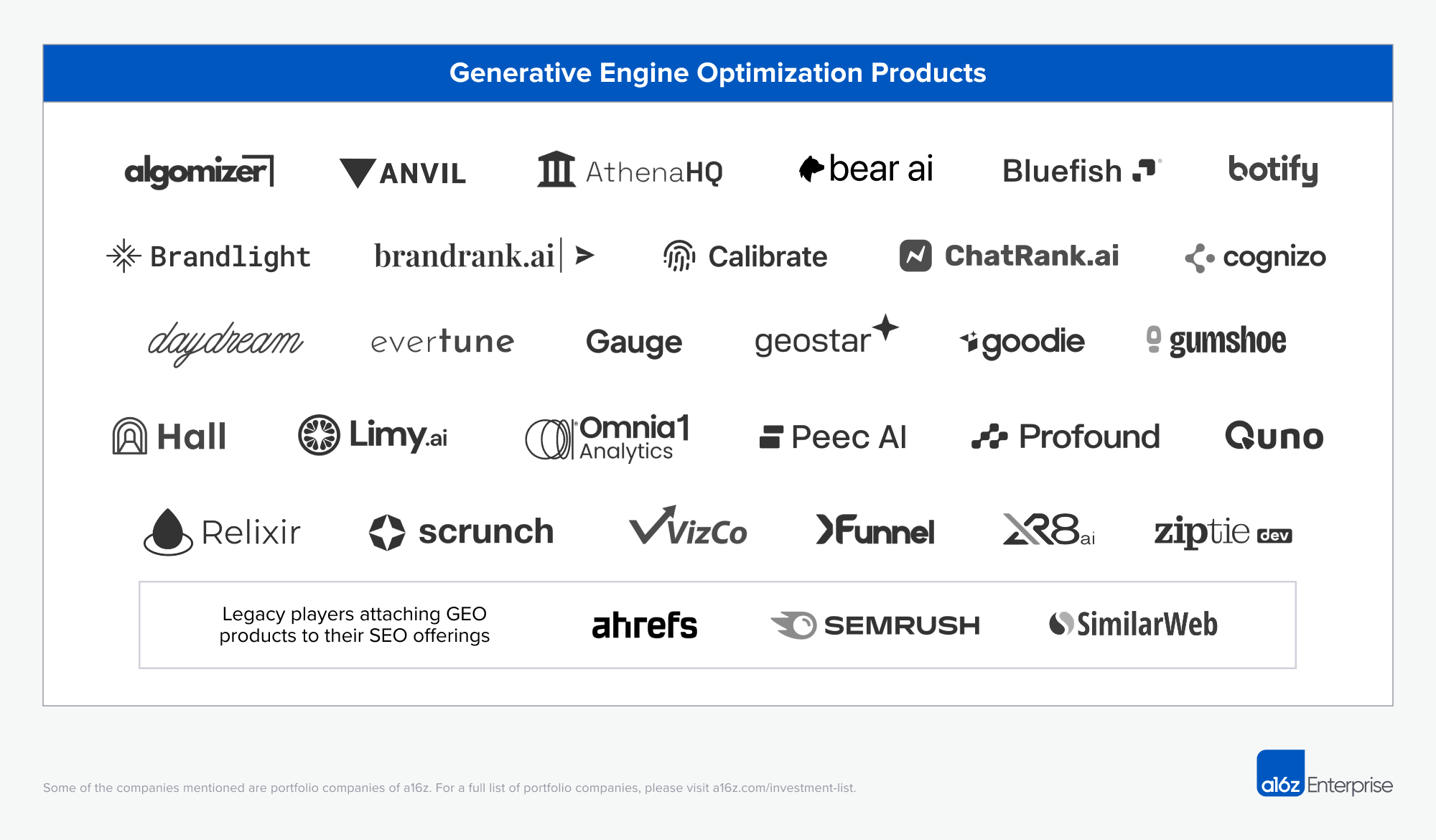
How can we forget the tech that powers GTM? GEO is rapidly becoming a category that may be more powerful than SEO. SEO surfaces a link to your content. GEO positions you to be a cited source for the entire answer.
This line from a16z says it all:
“The most compelling GEO companies won’t stop at measurement. They’ll fine-tune their own models, learning from billions of implicit prompts across verticals. They’ll own the loop—insight, creative input, feedback, iteration—with differentiated technology that doesn’t just observe LLM behavior but shapes it. They’ll also figure out a way to capture clickstream data and combine first- and third-party data sources.”
Recent research from Muck Rack (form-fill required), "What is AI Reading?" tackles a question that many of us have been grappling with—what type of content is most likely to be cited as a source for AI responses. Here's what they found by analyzing over 1M links from AI responses:
Over 95% of links cited by AI are non-paid coverage. Of those, >27% are journalistic content.
More than 89% of links cited by AI are earned media; only 11% fall into owned (including company blogs) or paid media.
High-domain authority outlets such as Reuters, Forbes, Axios, and Financial Times are often cited, but not consistently. Sources vary by industry with only ~15% overlap in sources appearing in the top 10 across different industries.
If you're a B2B marketer, PR/earned media should be a key component of your content strategy.
2) The Browser-AI Chatbot Convergence
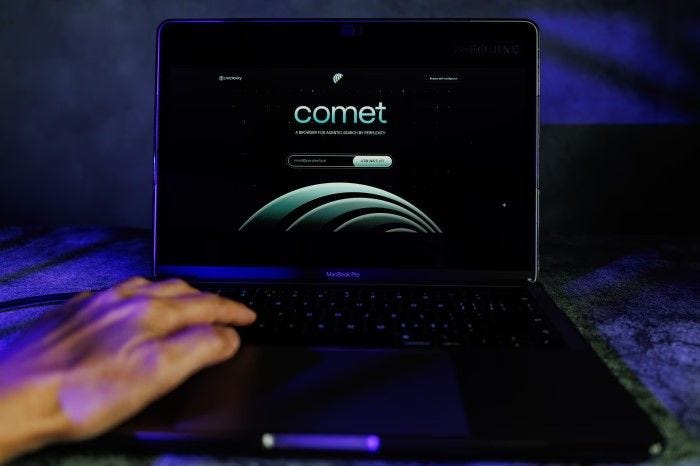
I recently tested Comet, the Perplexity agentic browser, and got a front-row seat to how B2B buying might evolve. My goal was to see how much I could get done without ever leaving the browser. I used the simple use case of booking hotels for a trip to Europe later this year.
Using AI voice mode (look, no hands!), I watched as Comet followed my instructions to pull up an itinerary (previously created with AI) from an Excel file stored on SharePoint. The AI Assistant on the side panel asked for my budget, who I was traveling with, if I wanted a "room with a view," etc. I replied in voice mode, gave more context, and asked it to provide booking links for recommended hotels, including TripAdvisor ratings and user review counts.
I tweaked my request verbally, asking Comet to only show hotels with available rooms that met my criteria for my exact dates. No problem updating based on real-time availability of rooms. The whole interaction took about 10 minutes, including downloading the Comet browser for the first time and providing all that context via voice. I never felt the need to leave the AI browser (caveat: payment needed to be made on the destination site by a human).
After just this one experience, I'm convinced that a B2B buyer will be able to get all the way to purchase or demo request—without ever leaving the browser, and relatively soon.
Company websites will remain an important source of information. However, we are at the point where we need to optimize site experience for real-time AI agents and LLM crawlers, not just humans. Almost all of the entire buyer journey will be self-service and take place on a single pane—the agentic browser. And as always, the recommendations of trusted colleagues will matter.
3) LLM Content Access Paradigm
What about the content used to train these general-purpose LLMs? Cloudflare, the internet security and traffic technology used by ~20% of websites, recently rolled out a feature that lets sites choose if and how LLM crawlers access their content (even introducing paywalls for AI, while still permitting SEO crawlers).
This raises some interesting questions: Most companies may want LLMs to crawl their sites, but media outlets might block or demand payment for AI access. If top media outlets block LLMs, should we expect changes in AI answer quality, neutrality, and authority? Do the brands who control high-authority content catalogs have real leverage? (e.g., Amazon pays NYT, Google pays Reddit.)
So, what’s a marketer to do?
If you’re holding on to an “SEO still drives way more traffic than GEO” world, it’s time to plan and act for a not-so-distant future where GEO will matter more. Playing catch up will be hard to do and small startups who build GEO-first content strategies may perform better than you. Start building omnichannel authority through earned media, customer reviews, social, and your own corporate site. Discovery is already migrating away from the SEO-dominated model. The shift to GEO isn’t years away. It’s happening right now and it’s not about AI hype; it’s the experience customers want.