


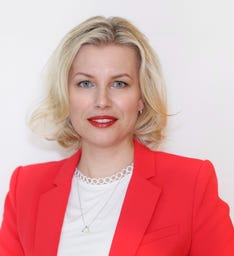
What does AI transformation look like when you’re responsible for global communications at a 160-year-old life sciences company? Diana Scholz would know. As Head of Global Comms for Bayer’s Consumer Health division, she’s navigating everything from GEO strategy to experimenting with AI-powered shareholder meetings while keeping her team grounded in the human skills that still matter. Diana and I first met through the Forbes Communications Council Content Marketing Group that I lead and recently connected over Teams (she dialed in from Basel, Switzerland while I hopped on from Seattle) to discuss how enterprise communications is evolving in real time and what this means for the next generation of comms pros embarking on a career in the AI era.
From Intern to Innovation Leader
Rekha: How did you get into Communications and find your way to Bayer?
Diana: I got into Bayer through a very classical internship while I was studying in Berlin. These were the times when we had physical boards, and there was a paper pinned there saying “We are looking for an intern.” I never wanted to work in big corporations; I was more looking to work as a journalist. I studied communication sciences, media, and political communication. But I saw this internship and thought, “Why not? It fits well timewise.” That was my first entry into the Bayer universe. Since then, I’ve never left. I did that internship, had a part-time working student contract while finishing my masters, and then started my first real job at Bayer. I grew up professionally in the company.
Rekha: Well, let’s jump from your professional start responding to a physical job notice to today. What is your take on AI as it relates to communications and marketing, and how have you embraced it within your team?
Diana: AI really, for anyone in our profession and industry, is the big thing. We cannot avoid integrating AI into our work both as communicators and knowing that the people we talk to are also doing the same. This has the same magnitude of change and impact as the Internet or email. We are in the early phase, although it’s developing fast and we need to be fast too. In big corporations like ours, speed is not always our biggest strength, but there’s an openness and ambition within our company overall to use AI and be at the forefront.
In life sciences, there’s tremendous potential for AI to speed up discovery of new drugs or develop new seeds for crops. For us in communications, it’s a big topic—one that has more opportunity than challenges. We are experimenting a lot as a team. Everyone in my team is pretty open to learn and dive in. We’ve made this part of our team meetings. Whoever has a new aha moment with something around AI or has learned something shares it, so we all get into the habit and it’s part of what we discuss regularly.
AI in Practice: Tools, Tests, and Transformation
Rekha: Can you share a specific example of how your team has experimented with AI?
Diana Scholz: As a company, Bayer developed our own tool called “myGenAssist” a ChatGPT-like secure generative AI platform for the simple reason that whatever we put in there is important data and we don’t want to give it away. Adoption rate is pretty high, especially by anyone who creates content—communications, marketing, legal colleagues, medical colleagues. We use it regularly to help us create content, meeting minutes, first press release drafts, and captions or answer questions and generate ideas. It is definitely part of my team’s day-to-day already.
A bigger project beyond just my team: as a Germany-listed company, we must hold an annual shareholder meeting, which is a massive full-day event where shareholders ask questions, and we’re obliged to answer every question in real-time. There’s lots of preparation beforehand to get potential answers ready. This year, we tried for the first time to have an AI run in parallel to the human-run process, just to test how good the responses would be in comparison to subject matter experts and how fast the AI actually captured the real question. That was our first bigger test on something highly regulated like an annual shareholder meeting.
As a communications team overall, we’re now also pulling together a dedicated team to develop our own agents for our function and really go to the next level. But this is in the infancy stage right now.
Rekha: How are you thinking about workflows? Do you need a human in the loop, or can things be handled autonomously by agents?
Diana Scholz: I would say AI is a partner or even like an additional team member in our team that everyone can bounce ideas with, get help being creative, get help with thought starters to draft a new article for our intranet or something. Everyone uses it. But you will always need strategic thinkers who really understand tonality and can bring the human voice into it, especially when we draft for leaders to speak.
There’s also that human empathy you sometimes need when it comes to internal communication when there are big transformations or announcements. You still need someone who can help contextualize and humanize the AI-produced content. Humans are needed and even more so. We need even more strategic and creative thinkers in communications to perfect the content.
This is especially true in healthcare and consumer health where there are emotional topics about people’s lives, their health, their well-being, and family members that they’re taking care of. You definitely need someone who can be emotional, who can relate to people, and who can translate that in the content we’re sharing.
Content Strategy: The Shift from SEO to GEO
Q: How is AI changing content strategy, especially with the shift from SEO to GEO?
Diana Scholz: The new criteria are part of the thinking as we put things up or think about what topics and content we’re pushing. Right now, we’re doing a revamp of our intranet and all our web pages, and there’s a whole work stream to look after GEO.
But we are at the beginning of fully understanding the potential. On a scale from one to five, everyone will probably say they’re on it and understand it. I would say we’re probably at a “two” in terms of fully grasping the opportunity. There’s way more potential and way more to think about and realize as we go. That train is leaving the station—we’re definitely on it, but we don’t know yet where it will take us fully.
Rekha: Are you navigating GEO internally or seeking external experts?
Diana Scholz: I would say it’s a hybrid approach with a little bit of external advice or help, but there’s a strong ambition to figure it out ourselves. I would say it’s 80-20 with 20% coming from external advice.
Rekha: That’s quite interesting. I’m definitely seeing a hybrid approach as well but in some cases that means 80% external help. A lot of it depends on size of company and internal expertise. In both cases, the goal is measurable results. With this segue, I’d like to shift gears to success metrics. How have KPIs changed for your team given all these shifts in workflow due to AI?
Diana Scholz: A lot has changed, but not necessarily because of AI—more because we are implementing a different way of operating in our company called Dynamic Shared Ownership, which is about flattening the organization, busting hierarchy and bureaucracy, and being much more outcome-focused. All our KPIs follow certain outcomes in 90-day cycles. That was not the case before. The cycles are much faster. It’s more about shared KPIs—teams that share the same outcomes. Whether they’re successful or not is really a team’s shared ownership or responsibility, not just one person or the leader.
Maybe I’m not seeing changes from AI yet. You don’t know what you don’t know. We’re in an infant stage in some sense, so more to come.
Advice for the Next Generation of Marketers
Rekha: Let’s switch gears and talk about marketers beginning their careers. What advice would you give someone graduating who wants to embark on a career in communications?
Diana: Two things are very important. Number one: be super open. Don’t have too much of “I want to do this and then three years this and then five years this.” When you’re too focused on something, you lose sight of what’s happening left and right, and you might overlook opportunities. I never wanted to work in a big corporation because I had a feeling of what it would be, but then I went there because there was an opportunity and I was proven wrong. I’ve been on an assignment in Japan, although I wanted to go to the US West Coast, that opportunity came up and it was the richest learning in terms of surviving in a very different culture. Life brings so many opportunities you can’t foresee. You can be ambitious, but you still need to be very open to whatever life brings you.
Second: meet people, network, be out there, talk to people outside of your industry, in your industry, of different generations, in different geographies. Learning from others and networking with others is the biggest asset that will help you grow.
Amazing content and so good to see it on Substack!