When I’m speaking with solopreneurs and small business owners, there’s a phrase that I hear over and over again, “I’m passionate about….”
Most of the time, it shows! On their faces, and in the excited way they describe their product, experience, or service. But as much as their excitement is contagious, I find myself holding my breath. Passion is not enough.
Do what you love is great advice, but when you’re building a sustainable, profitable business with limited resources, passion just gets you to the starting line. You need curiosity, perseverance, and a desire to experiment to get you through the long hours, missteps, successes and failures to follow.
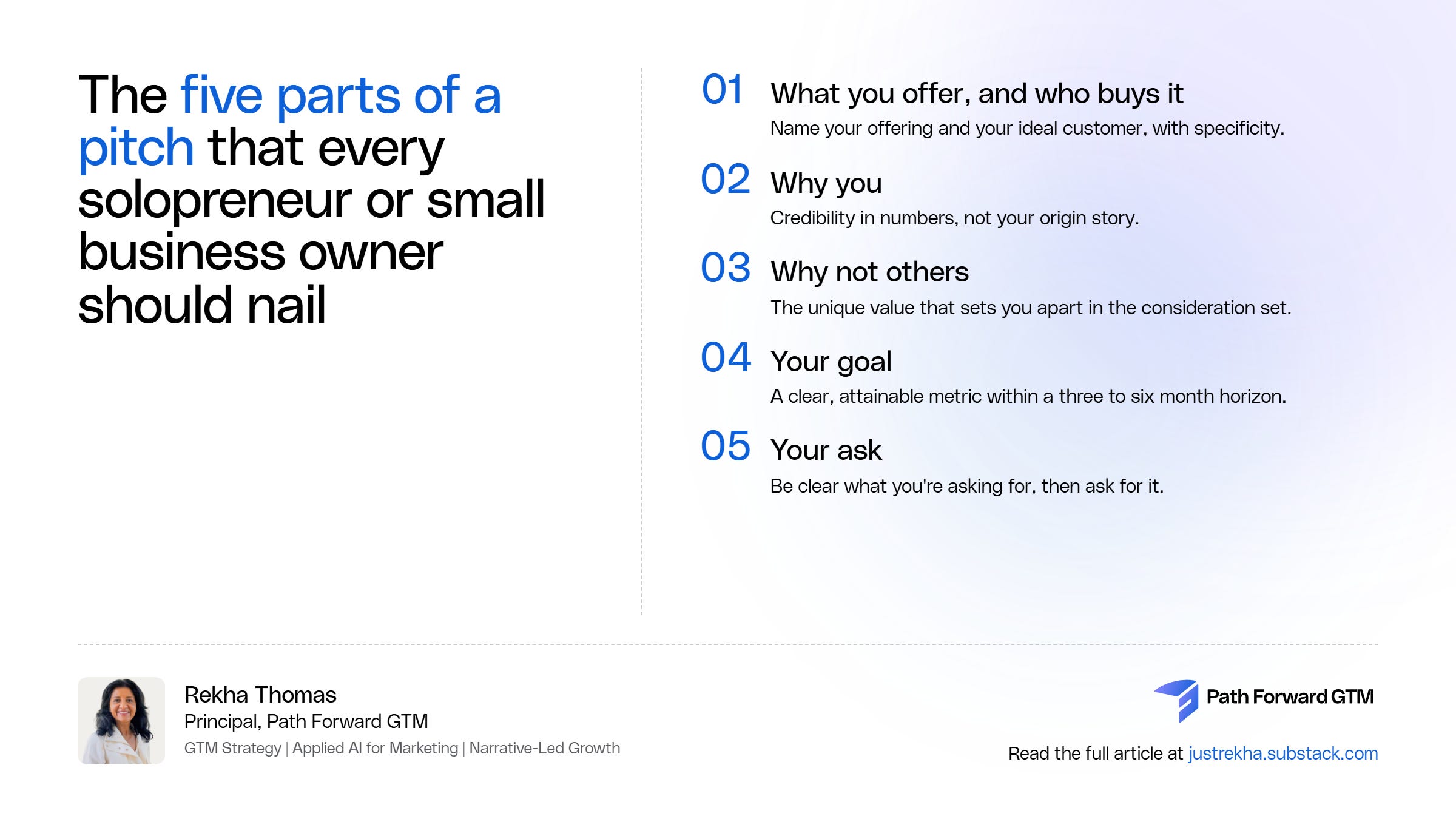
Whether you’re selling a niche consumer product, offering an experience, or providing a service, nailing your pitch matters. There are five parts of a pitch that are essential to get right.
1. What you offer, and who buys it
Start with what you make, the service you provide, or the experience you deliver. This is your offering. Then, be able to clearly articulate who your potential buyer is. This is your ideal customer.
Specificity matters. Naming your customer too broadly is a problem. If your customers are “women,” it doesn’t speak to a segment you can meaningfully serve. You need to be much more prescriptive about who you are targeting.
The same goes for your offering. Don’t just name the category of your business, but articulate what it does. “I sell clothing” isn’t specific enough. It doesn’t tell your audience anything they can act on. “I sell comfortable yet stylish outfits for professional women over 40” is better.
2. Why you
Once you’re specific about your offering and your customer, you have to demonstrate your credibility. This could be by sharing one or more of the following:
your years of experience
the number of customers you’ve served
your repeat purchase rate
how much you’ve sold
Wherever you can use a quantifiable metric, you should. Solid numbers beat superlative adjectives every single time: five years selling, 200 customers, 40 percent who buy again. It gives you and your business social proof and builds trust.
If you’re just launching, pre-customer credibility may look a little different and require you to surface the following:
years of training
industry or professional certifications
adjacent industry experience
your exclusive access to resources
Reluctance to share proof points is where many solopreneurs or small business owners tend to go wrong. They focus on their origin story. You may have a deeply personal reason why you decided to launch your business which ties back to your passion. It matters, but when it comes to a pitch, you want two things from your audience: you want them to either be interested in your service as a buyer or you’d like them to refer you to others who may be potential buyers. That calls for credibility not a backstory.
3. Why not others
Why should clients choose you and not the numerous other businesses or solopreneurs who do what you do? Identify your unique value proposition that clearly and simply sets you apart from the alternatives.
For a consumer product, service, or experience, that could be your production technique or delivery process. In the case of food, it could be a recipe that is yours and would be difficult to imitate. It could be where you source your materials, whether it’s a particular fabric or locally grown ingredients, or whether you have proprietary access to it.
It could also be your service model or how people buy from you. Is your product more convenient because you offer subscriptions or same-day customization? Perhaps it’s a combination of a product that comes with an in-person consultation based on your own expertise?
Then there’s price. Are you competing on being the lowest cost option, or do you have a premium offering? If you’re charging a premium price, your unique value proposition is even more important. Typically mid-tier pricing puts you in the messy middle where it’s is more difficult to build a compelling value proposition. My advice is to thoughtfully arrive at a position, premium or cost-conscious, based on your target customer.
4. Your goal
Next is your goal. Don’t pick a time frame that’s too far out. A general rule is that up to three to six months is the right horizon. It’s your goal, so why is it so important? It matters because of what comes after it. It sets up your ask, so that your audience understands why you’re asking them for something.
Most people want to support others and see them succeed. Setting a goal, a number, a date you’re working toward gives them something tangible to help you achieve. “I want to land 10 new customers in the next 90 days.” Be specific and make the goal attainable.
5. Your ask
The last part of the pitch is your ask, and it’s the one that most people leave out because it makes them uncomfortable. Keep in mind that unless you ask, you’re unlikely to get what you want.
Know what you’re asking for. Base the ask on where you are in your journey or stage of business. Are you looking for more people to be aware of your offering? Then, consider asking your audience to follow you on Instagram. Or are you ready to sell more product or services?
Most people err on the side of asking for the follow rather than leads who will pay. Read the room. If you’re speaking to a group, you can ask, “Do you know someone who is looking for the product that I offer?” Then make a specific ask such as, “I’d love three referrals from this group by the end of the month.”
The people in the audience either have a need for what you offer, or they may be in a position to help you. If the ask is general, you’re putting the work on them. If you make it specific and you’ve shared your goal, you’re making it easy for them to refer you, or identify themselves as someone who could use your service.
Three takeaways:
Don’t start with the pitch. Instead, start with the five components, and spend time reflecting on each one. This exercise requires deep reflection about target customer, product/service positioning, unique value, proof points, business goals, and what you need. This exercise should take the bulk of your time.
Remember that the pitch serves two purposes. You want your listener to be able to tell if your offering fills a need they have, or refer you to someone who has that need. To be successful, your pitch should serve both of these outcomes.
Keep your pitch simple enough to be repeated by others. If your description is too complex or too broad, your audience will lack the specificity that helps them identify a need they may have. They should be able to understand your pitch without follow-up questions. But the real test of a great pitch is whether the people hearing it could deliver it on your behalf, in a room where you’re not present.
If they can’t repeat your pitch, that’s your cue to go back to part one.