


The challenges that CMOs and senior marketing leaders face from CEOs remain largely the same:
We need more leads
We need a more qualified pipeline
No one seems to know our brand
Is anyone actually using all the tools in our MarTech stack?
And now, there’s one more to add to the list: How are we using AI to lower marketing spend?
And when it comes to that last one, using AI, many organizations are struggling to move past limited pilots to scaled workflows.
Not surprisingly, when a CEO asks their marketing leader about AI use, it's often framed as a question of efficiency. There’s no denying it. With thoughtful use of AI-augmentation, teams should be able to launch campaigns and products faster. They’ll also produce more content, though quality remains to be seen. Over time it may be entirely possible to personalize and scale entire campaign workflows orchestrated by humans, AI assistants, and agents. AI can and should drive efficiency.
But here’s the thing: responding to your CEO’s question by only detailing efficiency gains positions marketing as a cost center. And that’s a narrative that needs to change.
You’ve probably read numerous stories or experienced situations where the CMO function is completely eliminated, layered under other C-suite functions, or in some cases, broken apart and handed out piecemeal to other orgs. For example, product marketing moves under product and so on. (For more on this, read my Forbes article, “The Great Identity Crisis: How the CMO Role Lost Its Mojo”)
With this in mind, let’s reframe the CEO’s question. When you’re asked how your marketing team is using AI to drive efficiency, answer on your terms.
Marketing Use Cases for AI
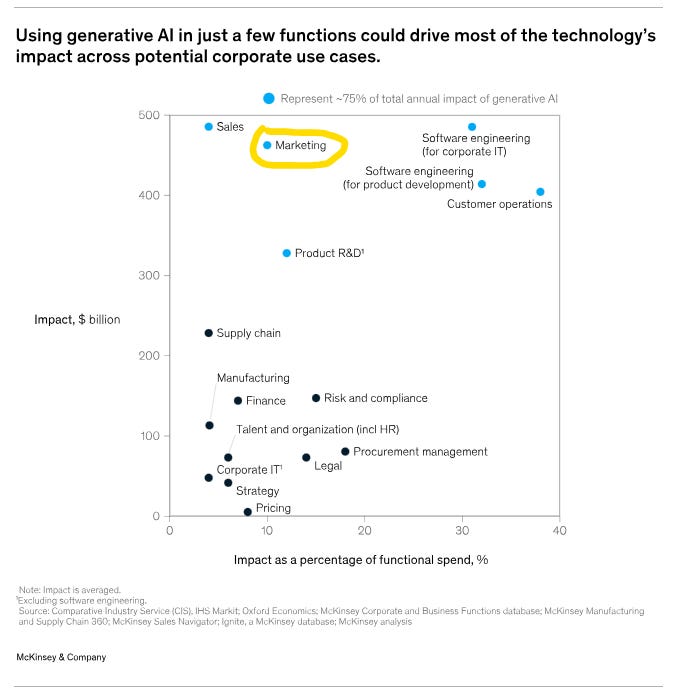
“Generative AI could add the equivalent of $2.6 trillion to $4.4 trillion annually across the 63 use cases we analyzed—by comparison, the United Kingdom’s entire GDP in 2021 was $3.1 trillion." — McKinsey
The projected productivity gains to global GDP from GenAI are mind-boggling. What matters for CMOs is that marketing ranks among the top three growth use cases, just behind sales and software engineering (for corporate IT). Software engineering (for product R&D) and customer operations round out the top five. The greatest impact of AI-augmentation in marketing that CMOs share should be growth—efficient growth.
What does AI High Performance Look Like in Marketing?
According to McKinsey’s 2025 State of AI survey, even though 88% of marketers now use AI daily only 5.5% of them reported that more than 5% of their organization’s EBIT is attributable to AI. These are the AI high performers.
What do they have in common?
They set growth and innovation as AI goals, not just efficiency.
They redesign workflows instead of bolting AI onto existing ones.
They pursue cost reduction AND revenue growth at the same time.
The Power of “Yes, and…”
So, next time your CEO asks you about AI efficiencies in marketing, consider a “Yes, and…” response. Discuss the efficiency gains from faster launches, hyper-personalized campaigns, and more content at scale, but don’t forget to include the growth component.
Yes, we’re seeing efficiency in these areas and we’re seeing AI drive growth. Personalized messaging and content, more precise targeting, quickly launching campaigns, and real-time optimization are unlocking growth. We can now customize and scale programs in ways we couldn’t before. We're tapping into new personas and hidden markets that were previously out of reach due to resource constraints. The results: a more qualified pipeline, greater pipeline velocity, and higher ARR.
When telling your AI in marketing story, remember that growth is the main character and efficiency is the supporting cast. Lead with growth. Support with efficiency. This reframing is critical to building CEO confidence in the CMO and ensuring go-to-market peers view marketing as a strategic function, not a supporting one.